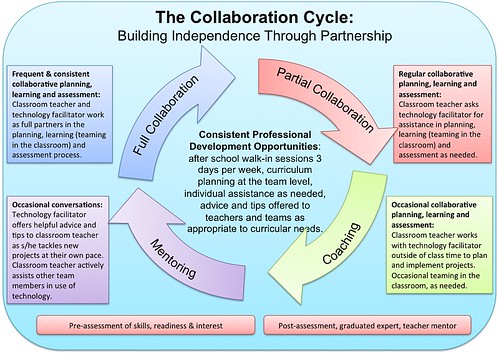
Once a school begins to build this culture of collaboration, it soon becomes second nature for teachers to work in partnership with the technology facilitator, bringing new and innovative ideas into the classroom, learning new ways to meet the needs of all students, and exploring the possibilities to connect, communicate and create on a global scale. This collaborative partnership is a powerful tool to increase student learning by combining the expertise of multiple educators.
Friday, March 26, 2010
Collaboration between Instructors & Tech Facilitators
Tuesday, February 02, 2010
Elearning and the iPad
Last week, Apple launched its long awaited iPad.
Here is a link to its capabilities and here is a link to its implications for eLearning.
While the first version of the iPad certainly has some eLearning limitations, I believe that future versions will have a significant influence on learning, especially in higher education.
Friday, October 02, 2009
Swine Flu
For months now we have been hearing about the swine flu and how to protect ourselves. As faculty, it's time to think of how to protect your courses! With today's technology it is possible to maintain class even during a flu epidemic. Using Blackboard, Wimba, email, and other online services, you can host class and collect assignments all from the convenience of home.
For a list of tips on teaching during a flu outbreak, please visit CTL's flu page.
For the latest information on the H1N1 virus from Regent University, read this update.
Friday, June 05, 2009
You may have heard of Twitter in the news or from your students, but did you know there are uses for this social messaging utility in higher education? For example, tweets between students and faculty can help minimize the pscyhological distance that often occurs in an online course.
Friday, May 15, 2009
Blooms DIGITAL Taxonomy
You may be familiar with Blooms Taxonomy of cognitive objectives, but did you know that there is an updated version? In 2001 Lorin Anderson, a former student of Bloom's, published the revised taxonomy. It remains a "continuum from Lower Order Thinking Skills to Higher Order Thinking Skills," but now includes activities and objectives that have emerged with the use of digital technologies in the classroom (such as blogging, podcasting, googling, editing, and social networking).
You can read a detailed description of each skill level at this article from Tech & Learning.
Thursday, April 30, 2009
NoodleBib
If you have ever wasted hours sifting through your preferred style manual (my department uses APA) looking for more information on how to cite that one, obscure source, then NoodleBib may be a good option for you. According to their website, NoodleBib is a:
“Powerful note-taking software that promotes critical thinking and creativity combined with the most comprehensive and accurate bibliography composer on the Web. MLA, APA, and Chicago/Turabian styles.”
I’ve been using it for about 5 years and recommend it to anyone who asks about online bibliography management. It’s loaded with features, flexible, and easy to navigate. Well worth the $8/year subscription. Check out the trial today at: Noodletools.com.
Bill Ventura, Ph.D.
Assistant Professor
Dept. of Communication, School of Undergraduate Studies
Thursday, March 12, 2009
Open Educational Resources Commons
“Learning is sharing,” states this website. A collection of higher education course materials and resources that is completely searchable, the Open Educational Resources (OER) Commons presents great potential for providing supplementary online resources for an array of disciplines including: Arts, Business, Humanities, Mathematics & Statistics, Science & Technology, and Social Sciences. Visit them at http://www.oercommons.org/